How POLAR Ensures Cold Chain Compliance in Maldives’ Island Logistics
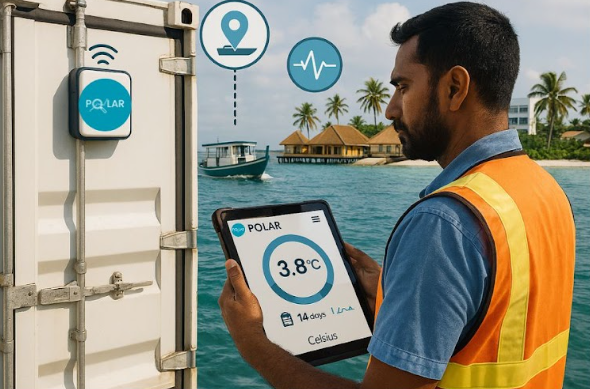
When someone thinks of the Maldives, they imagine pristine waters and luxury resorts. But for logistics professionals, it’s one of the world’s most complex and severe environments for cold chain compliance. The distance issues, the salt heavy air, and the relentless humidity are a constant threat to perishable goods.
While many systems claim to monitor temperature, SenzMate’s POLAR platform is designed specifically to not just monitor, but coordinate compliance in this island nation. Here’s how it tackles problems.
1. The “Last Mile” Problem is Actually a “Last Sea Mile” Nightmare
In the Maldives, the final delivery part isn’t a truck ride, it’s a dhoni boat transfer across choppy, salt sprayed waters. A standard data logger might record a temperature deviation but only after the damage is done.
What POLAR Does Differently: POLAR devices utilize a combination of Internet of Things (IoT) and GSM connectivity, switching seamlessly to ensure continuous data transmission even when a delivery boat is miles from any cell tower. This provides real time, not visibility. A resort manager expecting a shipment of premium wagyu beef can track its location as the dhoni leaves the main hub, enabling proactive decisions before it even docks.
2. Predicting Shelf Life, Not Just Recording Temperature
A temperature spike is bad. But its impact depends on the product, the duration of the spike, and its position in the cold chain. A brief door opening in an air conditioned warehouse is very different from a compressor breaking down for hours under the hot sun.
What POLAR Does Differently: POLAR’s AI driven analytics don’t just identify deviations. They calculate the remaining shelf life of the product based on its specific time and temperature profile. This means a distributor in Malé can instantly see which batch of tuna has 14 days of shelf life left and which has been compromised and now only has 7, allowing for dynamic prioritization and routing. This moves compliance from a reactive record to a proactive business intelligence tool.
3. Correlating Asset Health with Product Health
A refrigeration unit on the verge of failure is the single biggest threat to a cold chain. In the Maldives, where repair technicians and spare parts are often a flight away, predictive maintenance isn’t a luxury, it’s a necessity.
What POLAR Does Differently: POLAR sensors monitor more than just product temperature. They track the voltage fluctuations, and door open/close events of the reefers themselves. By analyzing data, the platform can predict mechanical failures before they happen, alerting logistics managers to service a unit before it ruins an entire shipment.
4. Automated Compliance for a Multi Stakeholder Chain
A shipment of pharmaceuticals might change hands five times: from the international freight forwarder to the Malé importer, to a domestic distributor, to a dhoni operator, and finally to a resort clinic.
What POLAR Does Differently: POLAR ensures that every temperature reading, every handover, and every location ping is recorded. This automatically identifies the exact place of the journey where a deviation occurred, streamlining accountability and insurance claims.
Conclusion
In the Maldives, maintaining the cold chain isn’t just about avoiding loss, it’s about guaranteeing quality, safety, and luxury in a remote paradise. POLAR goes far beyond simple temperature tracking. It provides real time visibility, predictive intelligence, and automated accountability across the most fragmented and challenging logistics landscape on Earth.
For resorts serving perfect champagne and fresh sushi, for hospitals storing vital vaccines, and for distributors managing this incredible feat daily, POLAR isn’t just a monitoring system, it’s the central nervous system for a compliant and competitive operation.
