Vision AI in Manufacturing: Making Quality Inspection Smarter
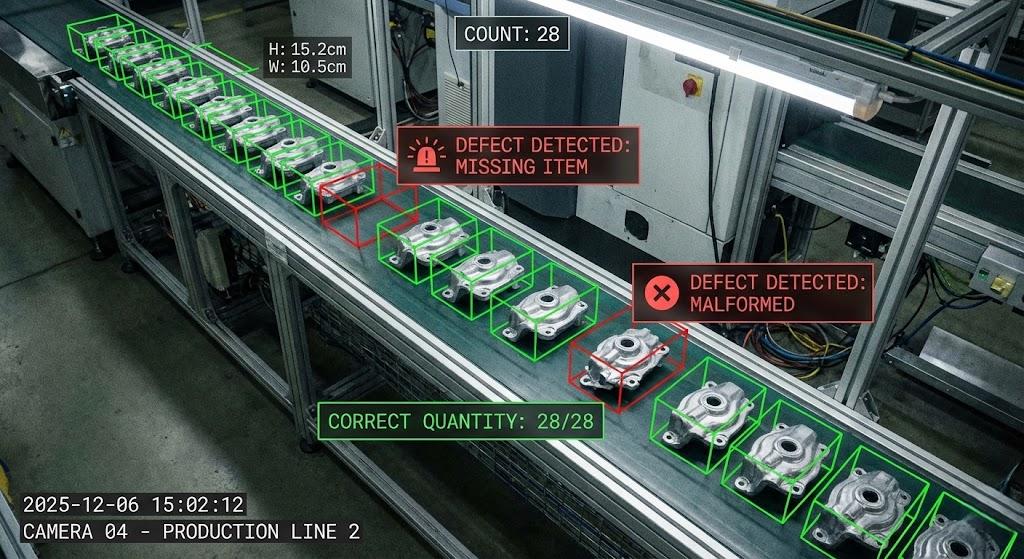
Quality inspection is still a major challenge for many manufacturers. As production lines become faster, checking every product manually can become difficult, especially when the same inspection has to be done again and again.
This is one of the areas where Vision AI in manufacturing can make a real difference.
Instead of depending only on people to identify every visual defect, AI can analyze images or video from the production floor and identify specific issues in real time.
Why Are Manufacturers Looking at Vision AI?
Manual inspection can work well, but it has some limitations.
When an operator has to check hundreds or thousands of products during a shift, small defects can sometimes be missed. Production speed, repetitive work, and human fatigue can all affect the inspection process.
There is also another problem.
If a defect is found only at the end of the production process, the manufacturer may already have a large number of affected products.
This is why many manufacturers are looking at AI visual inspection to detect problems earlier.
How Does AI Visual Inspection Work?
The basic process is quite simple:
Camera → AI Analysis → Defect Detection → Alert
The camera captures the product or process, and the AI model analyzes what it sees.
Depending on the use case, it can identify things such as:
● Printing defects
● Missing components
● Packaging issues
● Surface defects
● Incorrect assembly
● Other visual abnormalities
For example, if a manufacturer is producing printed packaging, Vision AI can be used to check whether the print is correct and identify predefined defects while production is running.
The important part is that the system is not just recording video. It is actually analyzing what is happening and identifying what matters.
From Finding Defects to Finding Them Earlier
One of the biggest benefits of automated quality inspection is the ability to identify an issue while production is still happening.
Imagine a printing defect starts appearing at 10:00 AM.
If the issue is found during a final inspection, the production team may have to check a large quantity of products that were produced after the problem started.
But if the defect is detected in real time, the team can be alerted much earlier and investigate what caused it.
This can help reduce unnecessary waste and give the team a chance to take action sooner.
But Is Vision AI About Replacing People?
Not necessarily.
In many cases, Vision AI works best as an additional layer of inspection rather than a complete replacement for human teams.
AI can handle repetitive visual checks, while people can focus on reviewing unusual cases, finding the root cause, and making decisions that require experience.
So the process can be as simple as:
AI detects → Team reviews → Problem is investigated → Action is taken
This makes the technology more practical for manufacturers who want to improve their existing quality-control process rather than completely change it.
What Should Manufacturers Consider Before Starting?
Not every inspection problem needs AI.
The best place to start is with a specific problem that happens repeatedly and can be identified visually.
Manufacturers should first ask:
● What exactly do we want to detect?
● Can the camera clearly capture it?
● Do we have examples of good and defective products?
● What should happen when a defect is detected?
Camera position, lighting, image quality, production speed, and the available data can all affect how well an AI quality inspection system performs.
Starting with one clear use case can also make it easier to test the actual value before expanding the solution across the production floor.
How SenzVision Fits In
At SenzMate, we are working on this problem through SenzVision, our AI-powered vision intelligence solution.
SenzVision can analyze existing camera feeds and help manufacturers identify visual defects, monitor processes, detect anomalies, and gain real-time visibility into what is happening on the production floor.
The idea is not simply to add another camera or another monitoring screen.
It is about making the visual data that manufacturers already have more useful.
For a manufacturer, the starting point can be one simple question:
What problem on our production floor could we detect earlier?
If the answer is something that can be identified visually, Vision AI could be a practical way to start improving the inspection process.
