Building Resilient Agriculture through Digital Innovation: Sri Lanka’s 2025 Story.
Introduction
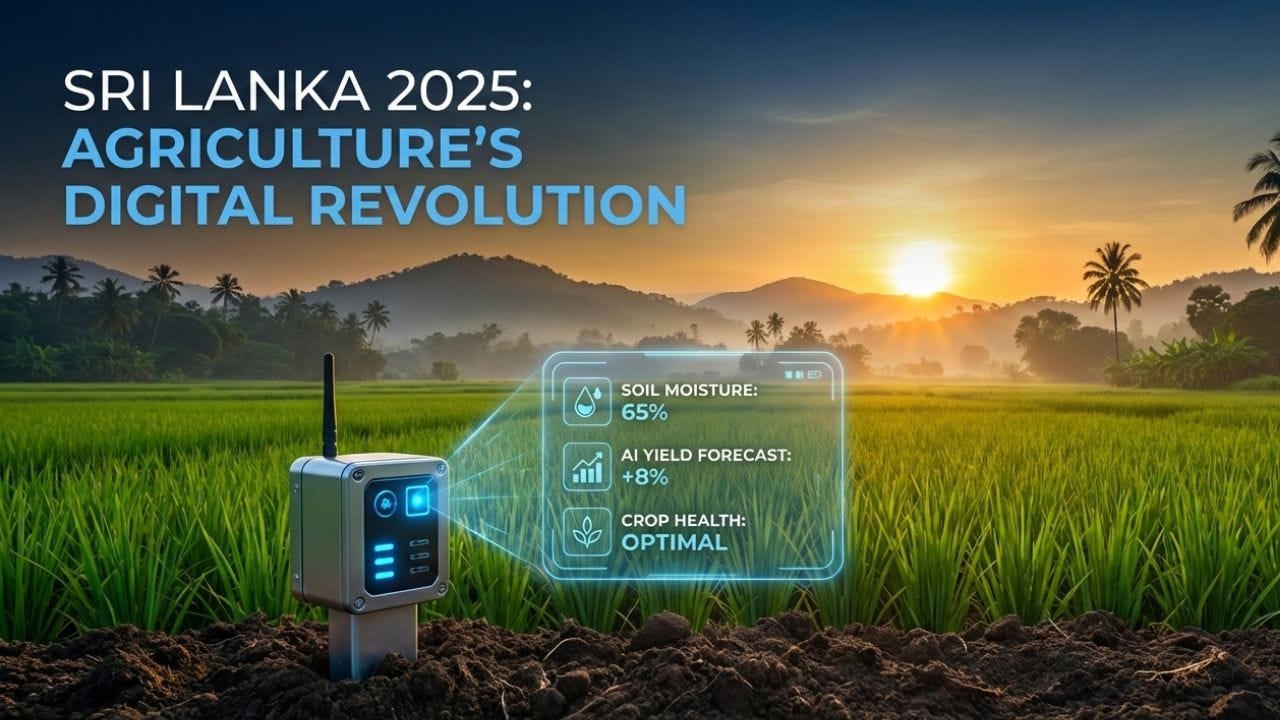
By 2025 Sri Lanka’s agriculture sector had passed through a fast-paced digital transition driven by government strategy, donor-supported pilots and private-sector platforms. After the crisis years around 2022–2023, agriculture contributed strongly to the country’s recovery (agriculture grew 8.3% in 2024), while digital programs ranging from national data-strategy documents to field IoT pilots accelerated adoption of precision and climate-smart practices. (Reuters: Jayasinghe, 2025)
This article traces the main technology-driven shifts in Sri Lankan farming through 2025, summarizes measurable outcomes, shows short charts for key indicators, and highlights the role of a local/private actor SenzAgro that has been active in the precision-farming space.
Highlights
- The government adopted an Inclusive Digital Agriculture Transformation (IDAT) strategy to mainstream data-driven decision-making across the agri value chain. (Agriculture Ministry)
- National and NGO pilots (e.g., GeoGoviya) rolled out climate services, SMS advisory and geospatial tools to improve smallholder decisions. (IWMI)
- Agriculture posted robust growth in 2024 (8.3% Year-on-Year) (YoY) and continued to show positive but more moderate year-on-year growth by Quarter 3 (Q3) 2025. (Reuters: Jayasinghe, 2025)
- Sensor/IoT pilots, farm dashboards, automation and AI-driven advisory moved from pilots into scaled services in pockets; especially for high-value and export-oriented crops. Scholarly reviews through 2025 show widespread IoT experimentation and clear scaling recommendations. (Gamage and Rathnayaka, 2025; Jayathilake et al., 2025)
- Startups and platforms (national & international) have been connecting sensors → dashboards → AI insights → markets (examples: SenzAgro and other solutions). (SenzAgro.com)
How digital tools changed Sri Lanka’s agriculture (the elements)
1) Sensors & IoT: real-time micro-climate and soil data
What changed: low-cost field sensors (soil moisture, EC, temperature/humidity), solar-powered telemetry, and basic weather/station networks enabled site-specific irrigation and fertigation decisions. Pilots and academic reviews in 2024–2025 document rapid growth in farm-level IoT experiments and growing evidence for water and input savings. (Gamage and Rathnayaka, 2025; Jayathilake et al., 2025)
Impact:
- Farmers with sensors could switch from time-based to condition-based irrigation, reducing water and pump energy use while maintaining (or increasing) yields.
- Export-oriented farms applied sensor data to meet traceability and quality requirements; smallholder use grew more slowly but mobile-based advisory bridged part of the gap.
2) Automation (irrigation, fertigation, remote control)
What changed: Automated irrigation controllers (linked to soil moisture and weather forecasts) became common in high-value horticulture and controlled-environment production (polytunnels, hydroponics). Integration with solar and low-power controllers made automation affordable to many growers. Agriculture projects in Sri Lanka integrated mechanization and automation within climate-smart irrigation investments. (Annual Report, 2024)
Impact:
- More precise water use, reduced labor for repetitive tasks, and improved uniformity, plus better compliance with export buyer specs where relevant.
3) Farm dashboards & farm-management platforms
What changed: Dashboards aggregate sensor streams, satellite/NDVI-derived crop stress indices, farm records (planting, inputs), and market signals into a single view for the farmer, agronomist, or aggregator. The national IDAT strategy explicitly prioritizes building interoperable data systems and a “Data & Decision Management System” for agriculture. (Agriculture Ministry)
- Faster diagnosis of emerging problems, improved traceability, and data-driven extension services.
- Dashboards enabled agribusinesses and cooperatives to scale advisory across many smallholders.
4) AI insights & predictive analytics
What changed: AI models for pest/disease alerts, yield predictions, and input optimization started to be used commercially and in research pilots. The advances were often hybrid: agronomic rules + ML models trained on local sensor + satellite + weather data. AI enabled stage-specific suggestions (fertilizer splits, irrigation windows) rather than generic advice. (SenzAgro. com)
Impact:
- Reduced risk (earlier detection of stress/disease), optimized input use, and in some cases measurable yield gains on pilot farms.
- AI enabled agronomic advice to be pushed as SMS/voice to lower-tech users where dashboards weren’t suitable.
Results
Measurable change through 2025: key data points
- Economic backdrop: Agriculture recorded 8.3% growth in 2024 (annual) as part of the country’s recovery. By Q3 2025 agriculture growth was still positive but moderated (Reuters reported agriculture up 3.6% YoY in Q3 2025). These macro numbers show resilience but also that growth rates can fluctuate year-to-year. (Reuters: Jayasinghe, 2025)
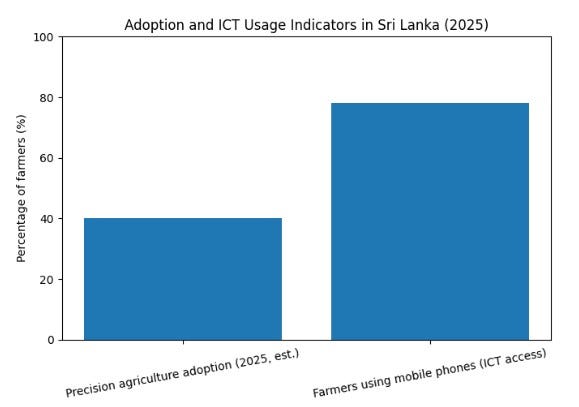
- Technology adoption & usage: Reviews and local studies (2024–2025) indicate IoT and precision experiments scaled across export/large farms first, with mobile phones remaining the most widespread ICT on small farms. A 2025 review documented the growing role of IoT and the need for scalable, cost-effective systems; a provincial study (Sabaragamuwa) found mobile phones were the single most-used ICT tool among farmers. (Gamage and Rathnayaka, 2025; Jayathilake et al., 2025)
- Adoption estimates: Industry summaries and regional trend pieces estimated that precision tools were reaching a substantial minority of farms by 2025 (some commentary put precision-farming adoption near ~40% of farms in certain segments/regions by 2025. This is an estimate aggregated from trend reports and should be read as indicative rather than uniformly national). (Farmonaut)
How SenzAgro contributed (summary)
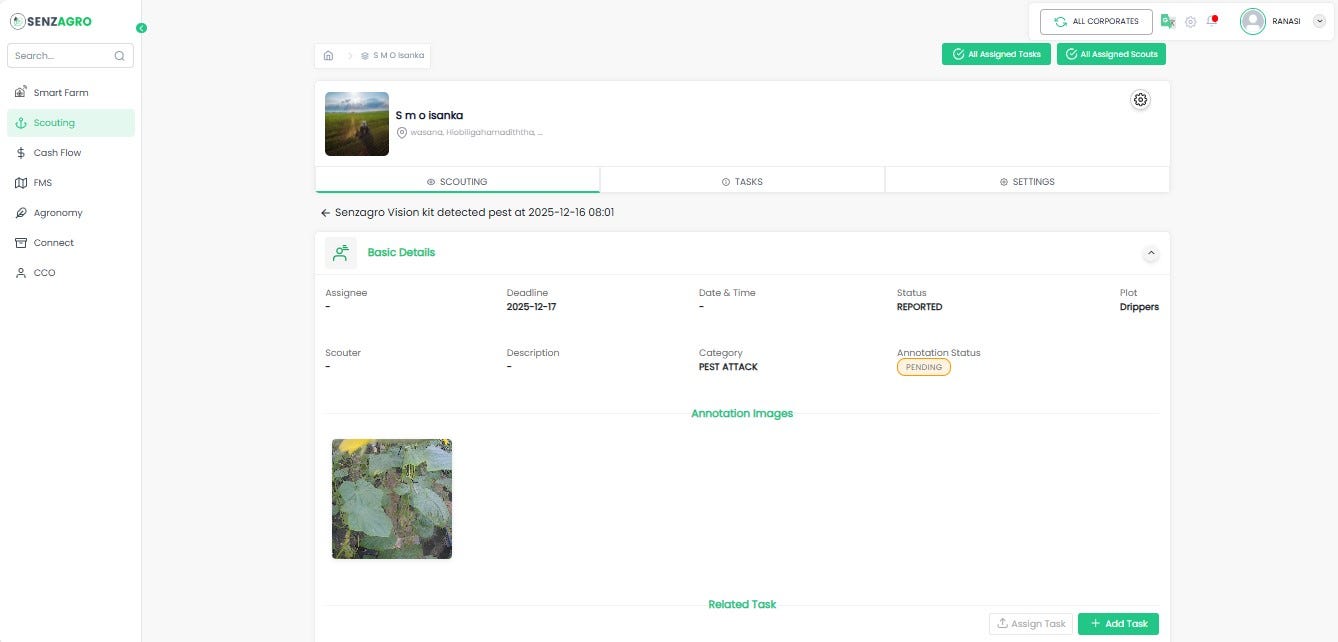
SenzAgro is an agritech platform offering IoT, sensor boxes, crop-specific analytics and marketplace features. Its public-facing materials describe a platform that collects on-farm microclimate and crop data, applies predictive analytics, and provides grower-level decision support and market linkages. In 2024–2025 SenzAgro positioned itself as a provider of precision solutions and farm dashboards suitable for small-to-medium growers in the APAC region.
Concrete contributions (by capability):
- Sensor + analytics stacks: affordable sensor boxes and cloud analytics to convert field telemetry into stage-specific agronomy suggestions.
- Farm management & traceability: farmer management systems and modules aimed at operational scaling (book demos, agronomist portals and buyer connectivity).
- Capacity building: webinars, localized onboarding and demos: critical to get smallholders from trial → regular use.
Note: SenzAgro is one of several private & research actors operating in Sri Lanka and the broader APAC region; the national IDAT strategy also envisions public-private partnerships and interoperability standards so platforms can interconnect with government systems.
Conclusion
By 2025 digital farming had become a core component of Sri Lanka’s agricultural recovery and resilience strategy. A combination of government planning (IDAT), NGO/CGIAR-backed pilots (GeoGoviya and partners), academic/extension research, and private platforms (including SenzAgro) pushed sensors, automation, dashboards and AI from proof-of-concept toward meaningful on-farm impact. The gains are real, better water use, earlier stress detection, improved traceability and targeted advisory but adoption remains uneven and depends on infrastructure, digital literacy and business models that align with smallholder realities.
Looking forward: scaling beyond pilot clusters will require interoperable data standards (a stated IDAT objective), finance models for low-cost sensors, and continued partnership between public extension and private platforms to reach millions of smallholders sustainably.
