Driving Circular Economy Transformation in Sri Lanka’s Food Sector with Smart Agriculture Solutions from SenzAgro
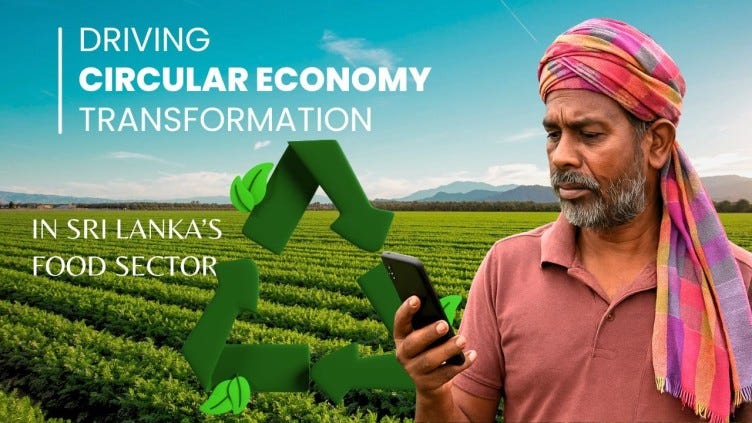
The Circular Economy (CE) is emerging globally as a path to sustainable growth by minimizing waste, maximizing resource use, and regenerating ecosystems. Unlike the linear take-make-dispose model, CE follows the principles of reduce, reuse, recycle, and regenerate. In agriculture, this means closing nutrient loops, reducing postharvest losses, optimizing inputs, and restoring soil health practices that cut costs, boost yields, and build climate resilience. But moving from concept to action requires real-time insights, precise resource management, and better market access, which is where smart agriculture technologies play a vital role.
Sri Lanka’s agriculture and food sector faces a critical challenge: a significant portion of farm production never reaches consumers’ tables. Farmers often struggle with postharvest losses, weak market linkages, and lack of fair trade opportunities. This gap between “farm production” and “food to table” not only leads to food waste but also undermines farmer profitability and food security.
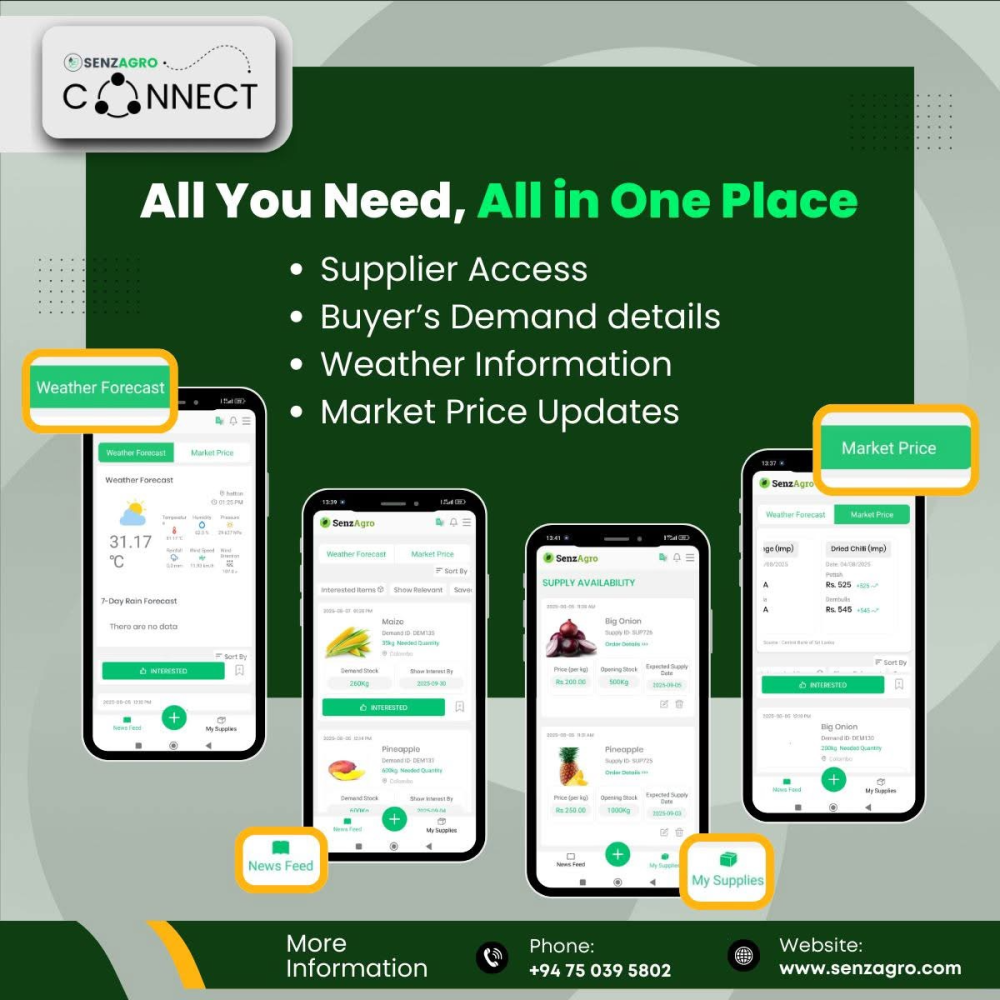
To address this, SenzAgro Connect introduces a smart, AI-driven platform that integrates agriculture with circular economy principles, ensuring that resources, harvests, and value are better preserved and fairly distributed.
Why do food waste and market inefficiencies remain a challenge?
- Without a cold supply chain, perishable produce can only last up to 3 days after harvest.
- Farmers must quickly find buyers; otherwise, by the second or third day, they are forced to sell at whatever price buyers demand.
- When many producers bring the same crop to market simultaneously, supply outpaces demand, driving prices down and increasing waste.
- Fair-trade opportunities are often lost, as farmers lack transparency and bargaining power.
This results in high postharvest losses and reduces both farmers’ income and national food availability.
What role does SenzAgro Connect play in closing Farm-to-Table gaps?
SenzAgro Connect directly addresses these inefficiencies through digital matchmaking and AI-powered forecasting, creating a transparent, fair, and waste-minimizing food system.
Key Applications and Processes:
- Data-Driven Forecasting
- The platform collects supply data months in advance (at least 2 months).
- Example: If 3,000 farmers are growing vegetables in a region, and only 200 will harvest between October 20–25, the system generates an estimation of total harvest volumes.
- This data is shared with buyers in advance, ensuring the market is ready for the supply and avoiding gluts.
2. Transparent AI-Based Matchmaking
- Farmers and buyers are connected through a transparent online platform.
- This creates a fair-trade environment where farmers are not forced into distress sales.
- Buyers benefit from predictable sourcing of vegetables, fruits, and grains.
3. Reducing Food Waste
- By aligning production with demand ahead of time, wastage is minimized.
- Instead of last-minute panic sales, farmers secure buyers before harvest.
- This process alone can reduce food wastage by up to 50%.
4. Empowering Farmers
- Farmers gain pricing control instead of being subjected to middlemen.
- Predictable demand helps them plan cropping cycles, reduce risks, and increase income.
Success Story of 2K Agro Products Ltd.
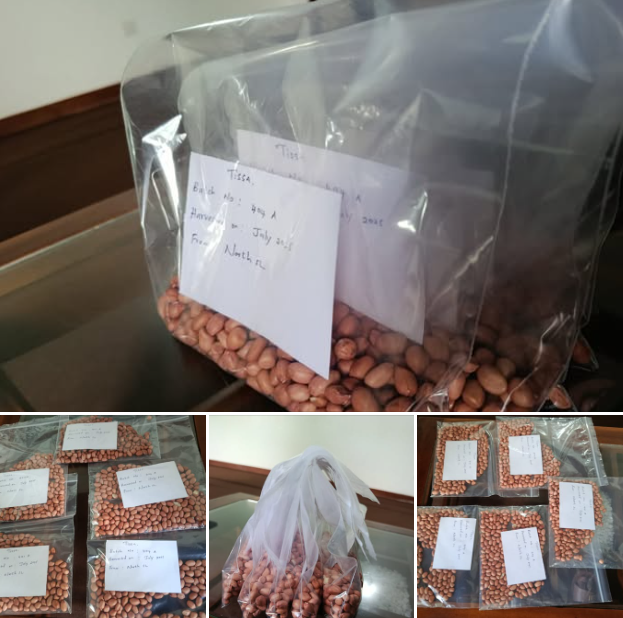
The farmer group 2K Agro Production proudly shared their success in partnering with SenzAgro (Pvt) Limited as their trusted intermediary for exporting Jumbo peanuts. With the expertise and dedicated support of the SenzAgro team, their harvest was smoothly managed from farm to table through the professional, AI-driven matchmaking platform. This ensured timely export operations, building confidence in both local producers and international buyers. Beyond facilitating trade, SenzAgro Connect also enabled circular economy practices in agriculture. By minimizing waste, the platform prevented surplus peanuts from rotting or being sold at low prices; by keeping resources in use, it ensured that every batch of farm production moved efficiently through the supply chain; and by creating fair value distribution, it provided transparency and trust for farmers, traders, and consumers alike. Through this digital ecosystem, 2K Agro Production not only secured export success but also demonstrated how smart agriculture and circular economy principles can work hand in hand to regenerate value, reduce losses, and build a sustainable food future.
Conclusion : A Path Forward
The transition to a circular economy in Sri Lanka’s food sector will require innovation, investment, and collaboration. By integrating CE principles with smart agriculture, SenzAgro demonstrates that it is possible to close resource loops, cut waste, and boost farmer livelihoods at the same time. With the right financial frameworks developed through stakeholder engagement, Sri Lanka has the opportunity to position itself as a regional leader in sustainable food production proving that smart farming is not just about technology, but about building a regenerative future.
